

Get more content that can help you
Content
Modern industrial equipment increasingly depends on cable systems that can withstand constant movement, repeated bending, oil exposure, mechanical abrasion, and demanding operating conditions. In applications such as electric hoists, light cranes, automated production lines, logistics conveyors, cable carriers, and mobile machinery, a cable must do much more than transmit electrical power. It must remain flexible, electrically stable, mechanically protected, and safe throughout its service life.
The YBF flexible locomotive cable is designed for these demanding conditions. It uses a nitrile-polyvinyl chloride compound, commonly identified as NBR-PVC, for both insulation and the outer sheath. This material combination provides a balanced performance profile that includes flexibility, oil resistance, abrasion resistance, flame retardancy, and environmental durability. Combined with an ultra-finely stranded annealed copper conductor, the cable is suitable for medium-load mobile equipment and industrial systems that require frequent bending.
Unlike conventional fixed-installation cables, the YBF design is intended to support movement. Its internal construction, conductor stranding, insulation system, and sheath structure are optimized for dynamic applications. The result is a cable that can follow complex bending paths while maintaining stable power and signal transmission.
Manufactured by Anhui Zhishang Cable Technology Co., Ltd., the YBF cable reflects the company’s broader capabilities in research, customized cable development, automated production, quality control, and integrated cable solutions. The product can be supplied in round or flat construction, with different conductor sizes and core counts available for project-specific requirements.
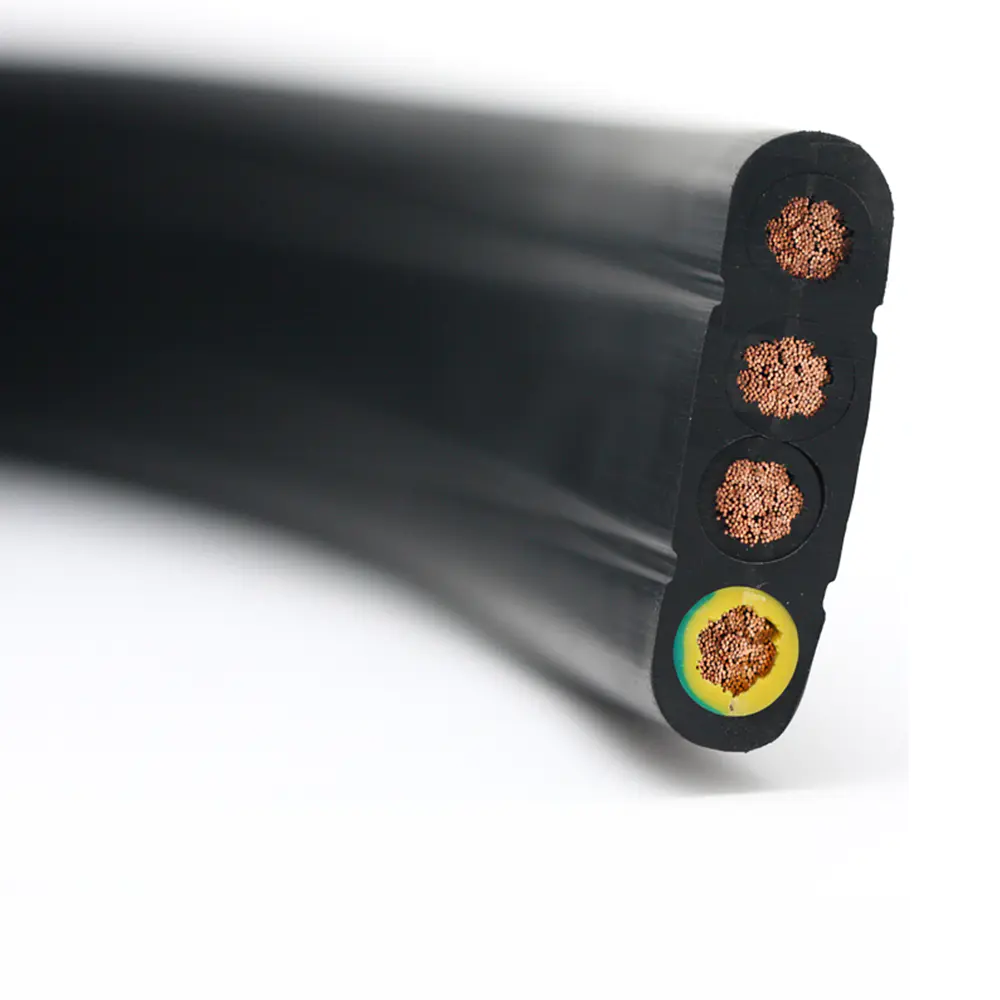
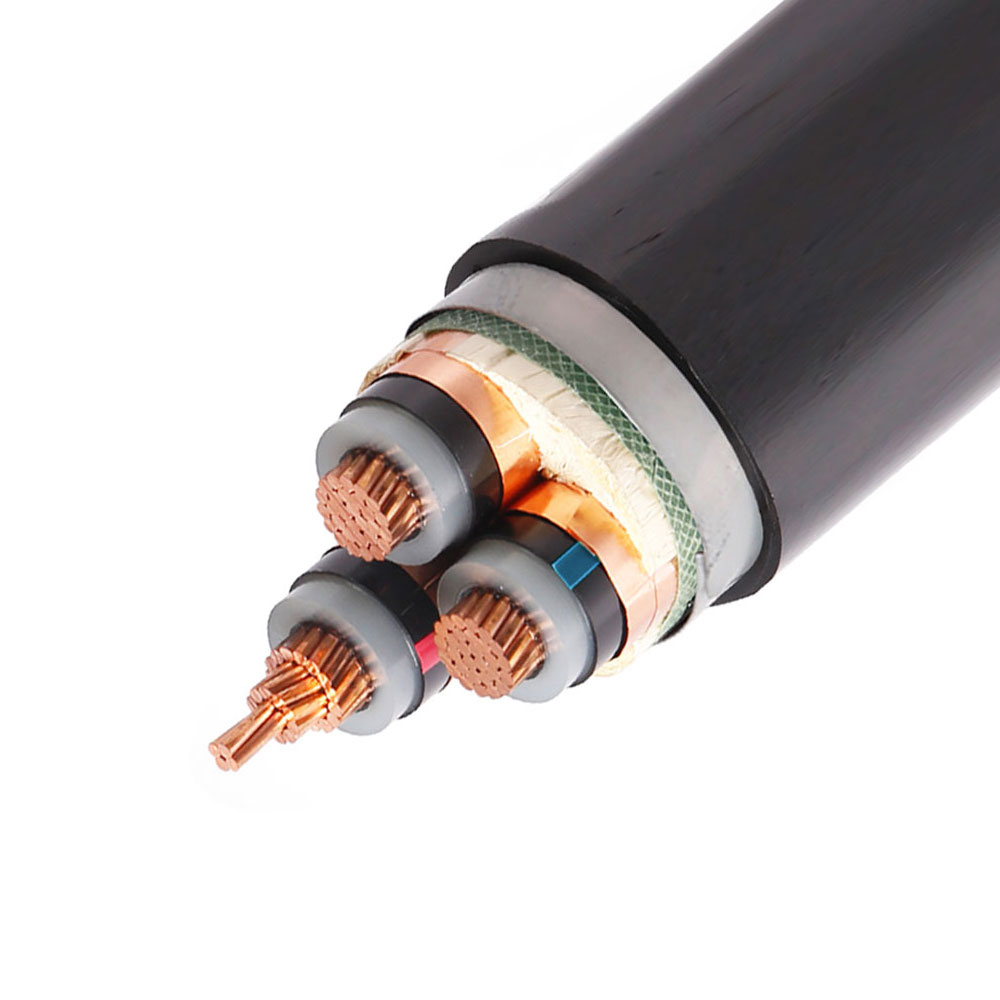
YBF Safety and durability Locomotive Cable
Many electrical cables are suitable for stationary installations but are not appropriate for continuous movement. A cable installed inside a machine may bend thousands or millions of times during its service life. If the conductor, insulation, or sheath is not designed for this motion, several problems can occur.
Repeated bending can gradually weaken the copper conductor. Excessive tension may cause individual strands to break. A rigid insulation material may crack when exposed to a small bending radius. The outer sheath may wear against a cable carrier, guide channel, machine edge, or nearby component. Oil and industrial fluids can also soften or swell unsuitable cable materials.
These failures may initially appear as intermittent electrical faults. Over time, they can develop into insulation breakdown, conductor discontinuity, short circuits, equipment stoppage, or safety hazards. In automated production, even a short period of downtime can create substantial costs because one failed cable may interrupt an entire production cell or material-handling system.
A specialized flexible cable addresses these risks through several coordinated design elements:
First, the conductor uses many fine copper strands rather than a single solid conductor or a small number of large strands. Fine stranding distributes bending stress across the conductor and allows the cable to flex more easily.
Second, the insulation and sheath use a flexible compound that can tolerate movement without rapidly cracking or losing mechanical integrity.
Third, the cable structure is designed to control the relative movement of the cores. A suitable internal arrangement reduces localized stress and helps the cable maintain a consistent shape during operation.
Fourth, the outer sheath provides a protective barrier against abrasion, oils, weak acids, weak alkalis, and other common industrial influences.
Finally, flame-retardant construction helps limit the spread of fire if the cable is exposed to an ignition source. This is especially important in production environments where electrical equipment, lubricants, and combustible materials may be present.
YBF is a flexible cable with nitrile-PVC compound insulation and a nitrile-PVC compound sheath. It is designed for mobile equipment and dynamic installations that require frequent bending, oil resistance, flame retardancy, and dependable electrical transmission.
The cable is available with cross-sectional areas from 0.75 mm² to 6.0 mm² and with approximately 4 to 48 cores. This broad range allows engineers to select a configuration for control circuits, power distribution, equipment wiring, and combined electrical functions.
The rated voltage is 300/500 V, making the cable suitable for many low-voltage industrial control and mobile equipment systems. A test voltage of 2 kV AC for one minute supports production verification of insulation integrity.
The temperature range is specified as -30°C to +70°C for fixed installation and -15°C to +70°C for flexible installation. The distinction is important because continuous movement places greater mechanical stress on the cable. Installation engineers should select the operating range according to the actual movement conditions and should also consider ambient temperature, bending speed, travel distance, and installation method.
YBF can be supplied in either round or flat construction. Round cables are often selected for general flexible routing, while flat cables can be useful in systems where space is limited or where a specific cable carrier configuration requires a flat profile.
| Item | Specification |
|---|---|
| Product type | Flexible locomotive and mobile equipment cable |
| Conductor | Stranded annealed copper conductor with ultra-fine stranding |
| Cross-section range | 0.75 mm² to 6.0 mm² |
| Number of cores | 4 cores to 48 cores |
| Rated voltage | 300/500 V |
| Test voltage | 2 kV AC for 1 minute |
| Insulation material | Nitrile-PVC compound |
| Sheath material | Nitrile-PVC compound |
| Fixed-installation temperature | -30°C to +70°C |
| Flexible-installation temperature | -15°C to +70°C |
| Minimum bending radius | At least 4 times the cable outer diameter for fixed installation; at least 6 times the cable outer diameter for flexible installation |
| Insulation resistance | At least 20 MΩ·km at 20°C |
| Flame performance | Complies with GB/T 19666 flame-retardant requirements |
| Oil resistance | Passes GB/T 2951.5 oil immersion test, Oil Resistance Grade I |
| Abrasion performance | Passes a 500,000-cycle reciprocating abrasion test |
| Bending life | At least 300,000 cycles for flexible installation |
| Structure | Round or flat construction available |
The material system is one of the most important factors behind the performance of YBF cable. Nitrile-PVC compound combines the flexibility and oil resistance associated with nitrile rubber with the processing advantages, flame performance, and practical durability of PVC-based materials.
Oil resistance is particularly valuable in industrial environments. Hydraulic oil, lubricating oil, cutting fluid, and other contaminants may contact cables installed near machinery. A sheath that is not designed for oil exposure can become soft, swollen, brittle, or mechanically weak. NBR-PVC helps the outer protection retain its intended properties in oil-contaminated working areas.
The compound also supports flexible operation. A cable used on an electric hoist, conveyor, cable carrier, or mobile machine must bend repeatedly without developing premature cracks. The material must remain sufficiently elastic across the specified temperature range and must work together with the conductor stranding and internal cable geometry.
Another advantage is abrasion resistance. Industrial cables may rub against guide channels, rollers, cable carrier components, machine frames, and other surfaces. The sheath must resist repeated contact instead of quickly thinning or exposing the underlying insulation.
Flame-retardant performance adds another layer of protection. YBF complies with the stated GB/T 19666 flame-retardant requirements and is designed to help limit flame propagation. This does not mean that the cable is fireproof or suitable for every fire-rated installation. Instead, it provides a controlled flame-retardant characteristic appropriate for the specified low-voltage industrial applications.
The conductor is made from stranded annealed copper, with an ultra-fine stranding structure. Copper provides high electrical conductivity, while annealing improves softness and flexibility. Fine stranding allows the conductor to move more naturally as the cable bends.
In a fixed cable, a solid conductor may be suitable and economical. In a dynamic cable, however, a solid conductor concentrates bending stress in a limited area. Repeated flexing can cause metal fatigue. A finely stranded conductor distributes this stress across numerous small strands, reducing the mechanical load placed on any single strand.
The conductor structure also improves handling during installation. A highly flexible cable can be routed around equipment, through a guide channel, or inside a compact machine space with less force. This helps reduce installation stress and makes it easier for technicians to achieve the recommended bending radius.
Electrical stability is equally important. High-quality copper conductors provide consistent resistance and reliable current transmission. When the cable includes multiple control or signal cores, stable conductor dimensions and careful manufacturing help maintain predictable electrical performance.
For project procurement, conductor size should be selected according to current, voltage drop, installation length, ambient temperature, grouping, duty cycle, and applicable electrical regulations. The available 0.75 mm² to 6.0 mm² range provides flexibility for many medium-load control and power applications, but final selection should always be confirmed by a qualified electrical engineer.
YBF cable uses NBR-PVC compound for both insulation and sheath. The insulation provides electrical separation between the copper conductor and adjacent cores. The outer sheath provides mechanical and environmental protection for the complete cable assembly.
The listed insulation thickness ranges from 0.4 mm to 0.8 mm, while sheath thickness ranges from 0.8 mm to 1.5 mm. These dimensions may vary according to conductor size, core count, cable structure, and production requirements.
A reliable insulation system must withstand electrical stress while remaining flexible. If insulation is too rigid, it may resist bending and place greater force on the conductor. If it is too soft or mechanically weak, it may be vulnerable to damage during production, installation, or operation. The NBR-PVC compound is selected to balance these requirements.
The sheath is the cable’s first line of defense against the external environment. Its oil resistance helps protect the internal structure in industrial locations. Its abrasion resistance supports use in moving equipment. Its flame-retardant properties contribute to workplace safety. Its tensile and tear resistance help maintain physical integrity when the cable is routed, guided, or moved repeatedly.
The two-layer protection concept is especially valuable in mobile systems. If the sheath is exposed to minor surface wear, the insulation remains as a secondary protective layer. At the same time, the strong sheath reduces the probability that normal contact will reach the internal cores.
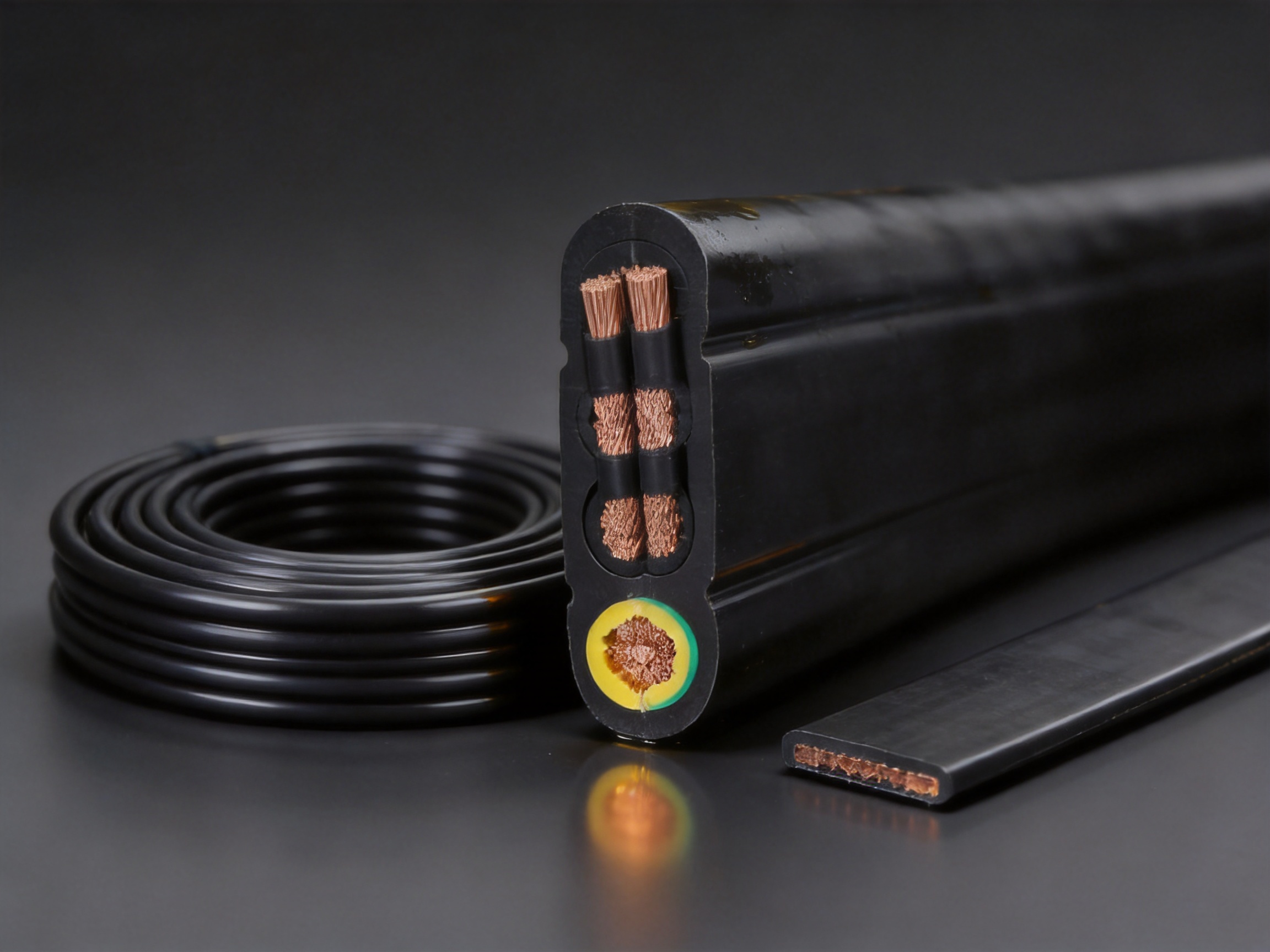
Flexibility is not defined by the conductor alone. It depends on the complete cable system, including conductor stranding, insulation hardness, core arrangement, filler selection, wrapping, sheath material, cable diameter, and installation method.
YBF is identified as an extra-flexible cable. Its design is intended for frequent bending and complex routing paths. The specified minimum bending radius is at least four times the cable outer diameter for fixed installation and at least six times the cable outer diameter for flexible installation.
For example, if a cable has an outer diameter of 20 mm, the recommended minimum radius for flexible installation would be at least 120 mm based on the 6× requirement. The bending radius refers to the radius of the curve rather than the full diameter of a loop. Installation teams should avoid sharp bends, twisting, pinching, and sudden changes in direction.
The stated bending life of at least 300,000 cycles for flexible installation provides an important reference for equipment designers. Actual service life will depend on the application. Factors such as bending radius, travel distance, movement speed, acceleration, cable weight, unsupported length, torsion, temperature, contamination, and guide-channel design can significantly affect results.
Proper installation is therefore essential. The cable should not be forced below its minimum bending radius. It should not be installed with unnecessary tension. In a cable carrier, the cable should have enough room to move freely without pressing against other cables or the carrier walls. The installation should also prevent twisting along the travel path.
When these principles are followed, the cable’s flexible structure can help reduce maintenance requirements and extend the operating period between replacements.
Industrial cable safety involves several independent performance areas. Electrical insulation prevents short circuits and leakage. Mechanical protection reduces physical damage. Flame retardancy helps control fire propagation. YBF combines these characteristics in one cable construction.
The product is specified to comply with GB/T 19666 flame-retardant requirements and to pass vertical flame tests under the applicable standard framework. Flame-retardant cable materials are designed to resist the spread of flame along the cable surface when exposed to a controlled ignition source.
This is valuable in production lines, material-handling systems, workshops, machine rooms, and other industrial environments where cable runs may be close to motors, power equipment, lubricants, or combustible materials. A flame-retardant cable can help reduce the chance that a local ignition event will rapidly travel along a cable route.
Flame retardancy should be considered together with correct circuit protection, grounding, installation, overload protection, and equipment maintenance. No cable should be treated as a substitute for a complete electrical safety program.
YBF also has a specified insulation resistance of at least 20 MΩ·km at 20°C. Its 2 kV AC test voltage for one minute supports factory verification of insulation performance. These characteristics help manufacturers and users evaluate the product’s electrical reliability before it is placed into service.
Industrial cables are often exposed to more than electrical stress. A cable may contact oils, weak chemical solutions, metal edges, dust, moisture, and air pollutants. A product designed only for clean indoor conditions may not provide sufficient service life in a production environment.
YBF passes the stated GB/T 2951.5 oil immersion test at Oil Resistance Grade I. This performance is relevant to machine tools, automotive manufacturing equipment, logistics machinery, hoists, and other systems where oil or lubricants may be present.
The cable also passes a 500,000-cycle reciprocating abrasion test. This test result indicates that the sheath has been evaluated for repeated mechanical contact under specified conditions. In practice, cable routing should still be designed to minimize unnecessary rubbing, because severe misalignment or excessive pressure can damage even a wear-resistant product.
Resistance to weak acids and alkalis provides additional protection in industrial environments. Cleaning agents, diluted processing chemicals, and other substances may be present around production equipment. Chemical compatibility should be reviewed for each specific substance and concentration before installation.
YBF is also specified to pass the IEC 60811-2-1 ozone test. Ozone resistance can help reduce the risk of surface cracking in environments where ozone exposure may occur. This is another example of how material selection contributes to long-term sheath reliability.
The listed tensile strength values, including a tensile strength of at least 10 N/mm² and a tensile resistance value of at least 12 N/mm², indicate that the cable construction is intended to withstand normal mechanical forces associated with handling and operation. Cable weight should not be suspended from the conductors, and separate support systems should be used when required by the equipment design.
Dynamic movement can affect more than mechanical durability. It can also influence electrical transmission. Repeated bending, vibration, conductor movement, and electromagnetic activity from nearby motors or drives may create unstable signals or intermittent connections if the cable is poorly designed or incorrectly installed.
YBF is described as using a low-capacitance design and a high-quality shielding layer to help suppress signal interference. These characteristics are useful in equipment where power and control functions operate in the same moving system.
Stable transmission is important in automated production lines, robotic equipment, logistics sorting systems, and machine tools. A small control signal interruption can cause a sensor to misread, a drive to stop, or a machine sequence to reset. A cable that maintains consistent electrical behavior during movement helps support overall equipment reliability.
For installations involving sensitive communication or high-speed data signals, engineers should verify whether the selected YBF configuration meets the required impedance, capacitance, shielding, transmission frequency, and EMC performance. The cable’s suitability depends on the actual system requirements and should not be assumed solely from its general flexible-cable classification.
Good installation practice also affects interference performance. Power and sensitive signal circuits may need to be separated. Shielding should be terminated according to the equipment manufacturer’s instructions. Grounding and bonding should be planned as part of the complete system rather than treated as an afterthought.
The principal advantage of YBF over standard fixed-installation PVC cable is its suitability for movement. Conventional fixed cables may perform well inside control cabinets, building wiring, and stationary equipment. However, their conductor stranding and sheath composition may not be optimized for repeated bending.
Compared with basic flexible PVC cables, YBF adds a stronger focus on oil resistance, abrasion durability, flame retardancy, and dynamic service life. This can make it a better choice for industrial equipment exposed to mechanical movement and contaminated environments.
Compared with some rubber cables, NBR-PVC compound can offer a practical balance of flexibility, processability, flame performance, and cost. Rubber-based products may be preferred for certain extreme-duty environments, but they can involve different handling, sizing, chemical, or procurement considerations. YBF is positioned as a flexible medium-load solution for applications requiring a combination of performance characteristics rather than a single specialized property.
Compared with ordinary multi-core control cable, the YBF design is more suitable for cable carriers, mobile machinery, hoisting equipment, and other systems with recurring movement. The ultra-fine copper stranding, flexible compound, and reinforced outer protection provide advantages where repeated bending is a primary operating condition.
Compared with low-cost cables that emphasize initial purchase price, YBF can offer a stronger total-cost proposition when service life, downtime, replacement labor, and maintenance access are considered. A cable that lasts longer in a dynamic application may reduce interruptions even if its initial price is higher than that of a general-purpose fixed cable.
| Evaluation factor | Conventional fixed cable | Basic flexible cable | YBF flexible cable |
|---|---|---|---|
| Frequent bending | Limited suitability | Suitable for moderate movement | Designed for repeated dynamic movement |
| Oil resistance | Depends on material | May be limited | NBR-PVC compound with stated oil-resistance performance |
| Abrasion resistance | General-purpose protection | Varies by sheath design | Evaluated through a 500,000-cycle reciprocating abrasion test |
| Flame retardancy | Depends on product grade | Depends on product grade | Complies with stated GB/T 19666 requirements |
| Conductor structure | Solid or standard stranded | Stranded | Ultra-fine stranded annealed copper |
| Application focus | Stationary installations | General flexible routing | Mobile equipment, cable carriers, hoists, conveyors, and automation |
| Configuration range | Often standardized | Moderate selection | 0.75 mm² to 6.0 mm² and 4 to 48 cores |
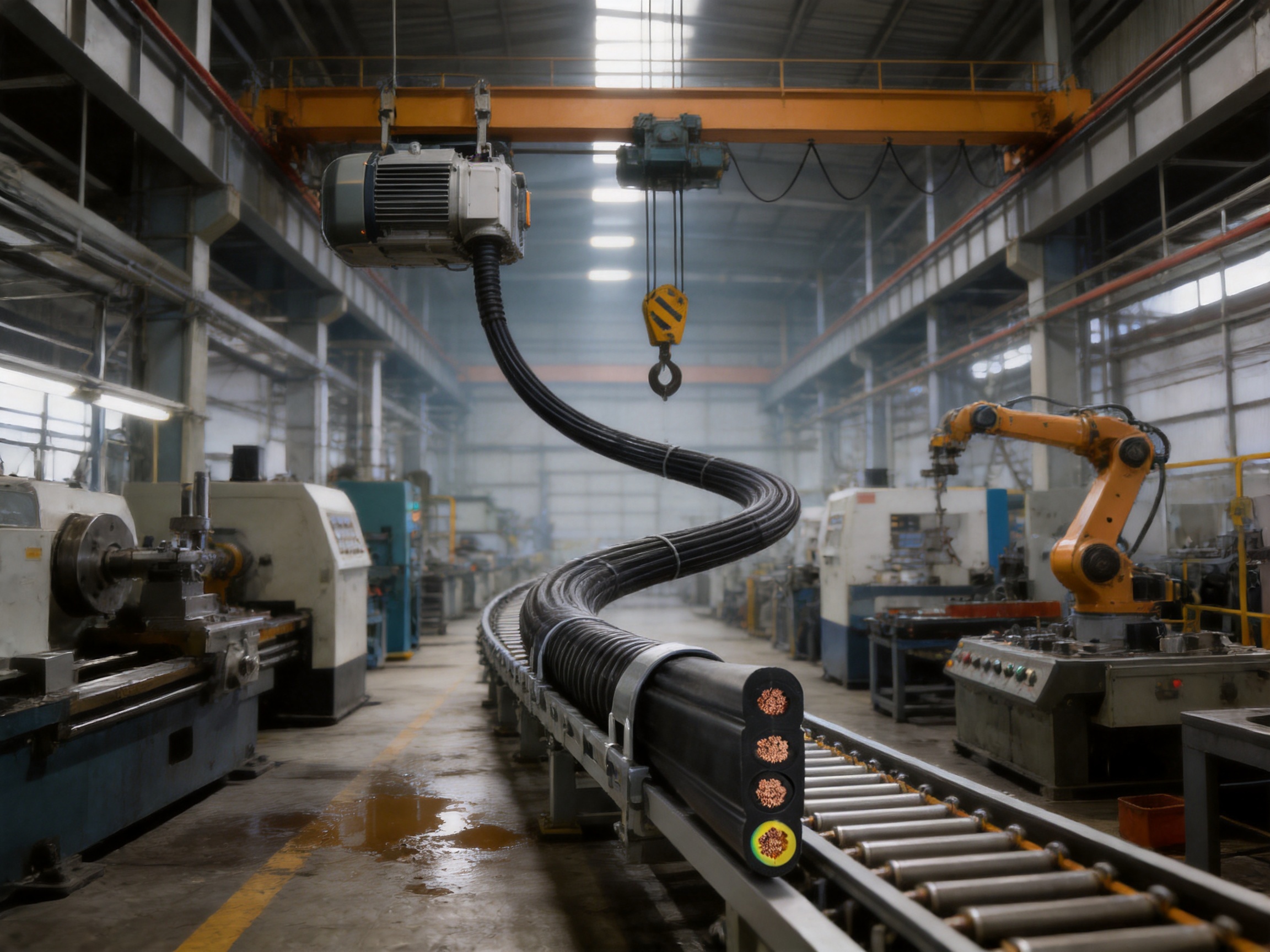
Light cranes and electric hoists require cables that can follow movement while withstanding vibration, suspended routing, and contact with industrial oils. YBF can be used for suitable low-voltage control and power circuits where the rated voltage, conductor size, core count, and mechanical conditions match the project requirements.
The cable’s flexibility supports movement along the hoist travel path. Its abrasion resistance helps protect against repeated contact with guide components, while the NBR-PVC sheath provides useful protection in workshops and production facilities.
Small overhead cranes often operate in factories, warehouses, workshops, and maintenance areas. Their cables may travel horizontally or vertically and may be exposed to dust, vibration, oil, and temperature changes.
The YBF structure is suitable for applications where a flexible multi-core cable is needed for crane controls, limit switches, auxiliary functions, or other low-voltage circuits. Installation should account for cable weight, travel distance, support points, and minimum bending radius.
Automated logistics systems depend on continuous movement. Conveyors, sorting systems, lifting units, transfer carts, and warehouse machines may operate for long hours with frequent starts and stops.
A flexible cable with stable electrical transmission can help reduce unplanned interruptions. The available multi-core configurations support systems that require several control circuits in one cable assembly. The sheath’s resistance to abrasion and industrial oils is also useful in busy logistics environments.
Production lines often combine sensors, actuators, motors, valves, control devices, and safety circuits. Cables may run through moving stations, cable carriers, robotic cells, or adjustable machine modules.
YBF can provide a practical connection solution for medium-load mobile equipment. Its extra-flexible grade supports recurring movement, while the flame-retardant construction provides an additional safety feature for industrial production spaces.
Mobile mechanical equipment may include machine modules, lifting platforms, service units, compact processing equipment, and other machinery that changes position during operation. Such applications often require cables that are compact, flexible, and resistant to environmental exposure.
The round or flat structure options allow designers to select a format that fits the available routing space. The final cable selection should consider whether the equipment produces bending only or also introduces torsion. Standard flexible cable designs should not be used in applications with uncontrolled twisting unless the manufacturer has confirmed suitability.
Automotive manufacturing facilities include welding areas, assembly lines, material-handling systems, inspection equipment, and automated stations. These areas may expose cables to oils, vibration, metal particles, and repetitive mechanical motion.
YBF’s combination of flexibility, abrasion resistance, oil resistance, and flame retardancy makes it suitable for selected low-voltage equipment connections in this environment. Cable selection must consider welding sparks, elevated radiant heat, sharp metal edges, and the exact chemical exposure present in each production area.
Machine tools require reliable connections for motors, controls, sensors, switches, and auxiliary systems. Cable movement may occur through sliding covers, carriers, adjustable axes, or service loops.
The product’s fine-stranded copper conductor and flexible sheath can support repeated routing movement. Its oil-resistant construction is particularly relevant where cutting fluids and lubricants are present. Engineers should verify compatibility with the specific coolant or chemical used by the machine.
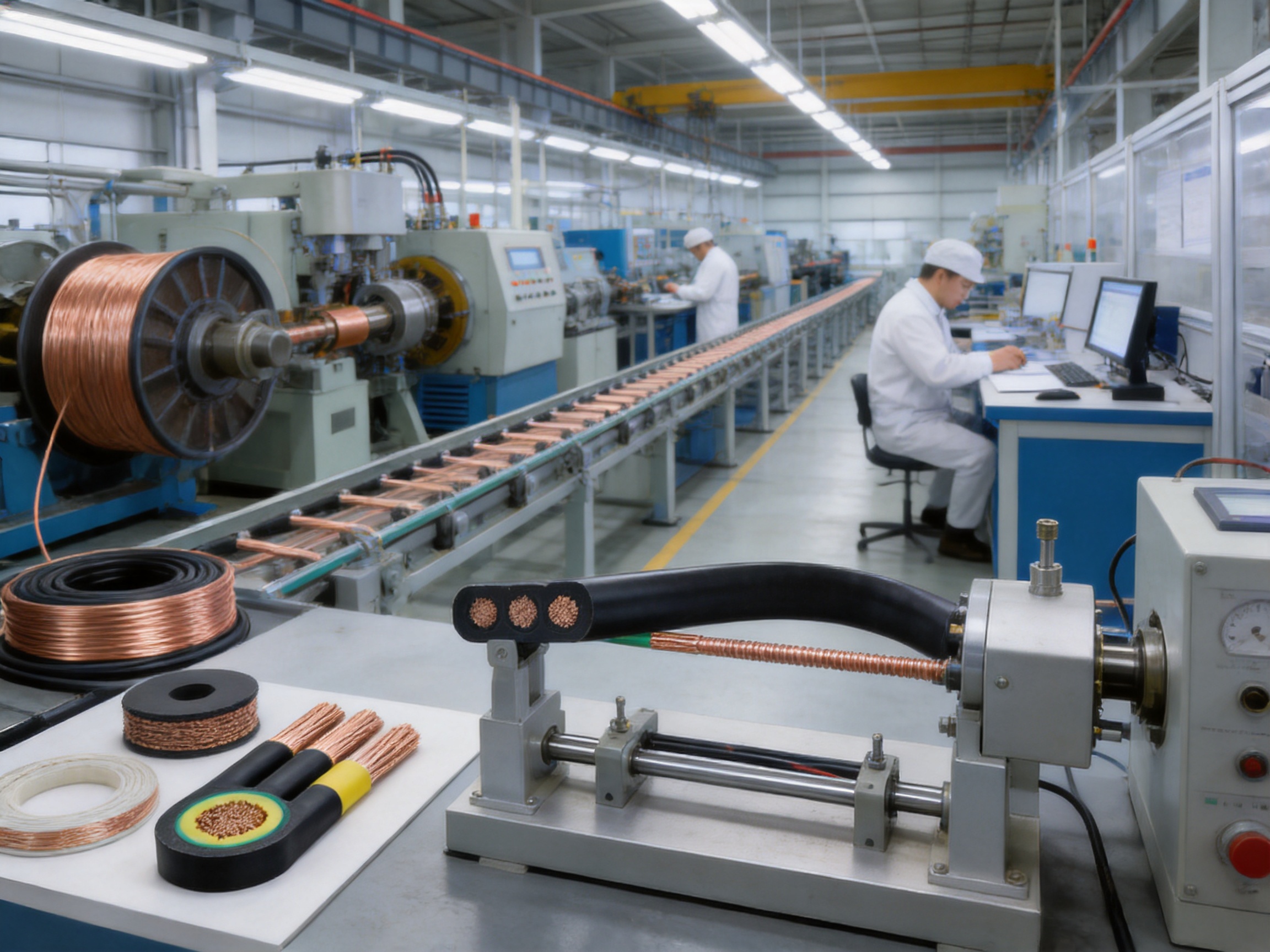
An industrial cable’s performance depends not only on its product design but also on manufacturing consistency. Anhui Zhishang Cable Technology Co., Ltd. integrates research and development, production, quality management, and sales support.
The company operates a modern production base of approximately 5,000 square meters and has more than 50 employees, including quality engineers and research and development technicians with more than 10 years of industry experience. This combination of manufacturing resources and technical personnel supports the development of cables for industrial automation, intelligent manufacturing, appliance equipment, power engineering, weak-current projects, and other fields.
The company operates 10 automated production lines with a stated monthly output of up to 10 million meters. Automated production can improve process consistency, production efficiency, dimensional control, and repeatability when supported by suitable inspection procedures.
For a product such as YBF, manufacturing control is important at every stage. Copper must be properly drawn, annealed, stranded, and inspected. Insulation must be applied evenly. Core identification must remain clear and consistent. The cable assembly must maintain appropriate geometry. The outer sheath must be extruded with controlled thickness and a smooth surface.
Production is also supported by product testing and quality assurance. The company provides full-core and full-length pure copper specifications, product test reports, and warranty support for standard cable models. These measures help customers verify what they are purchasing and support traceability during project acceptance.
The conductor production process begins with suitable copper material. Drawing operations reduce the copper to the required dimensions. Annealing restores flexibility after drawing by controlling the copper’s mechanical properties. Fine stranding then combines the individual wires into a flexible conductor.
Conductor consistency affects electrical resistance, flexibility, diameter, and compatibility with downstream insulation extrusion. Careful process control helps ensure that different production batches remain close to the specified characteristics.
Insulation extrusion applies the NBR-PVC compound around each conductor. The process must control temperature, pressure, line speed, concentricity, surface quality, and insulation thickness.
Uniform insulation is essential because thin areas may reduce electrical and mechanical protection, while excessive thickness can increase cable size and reduce flexibility. Online dimensional monitoring and sample testing can help identify deviations during production.
Multi-core cables require reliable core identification. Color-coded conductors make installation, maintenance, testing, and troubleshooting more efficient. YBF is described as supporting color-coded conductors for compatibility with common flexible connectors and cable-carrier guide channels.
During assembly, the cores must be arranged and combined in a manner that supports flexibility and reduces internal stress. The cable geometry should remain stable as it moves, bends, and changes direction.
The outer NBR-PVC sheath is extruded over the assembled cores. Sheath thickness, surface finish, concentricity, and bonding behavior are controlled during this operation. The final sheath must protect the internal cores while retaining enough flexibility for dynamic use.
Depending on the cable configuration, the final product may be produced in round or flat form. Production equipment and tooling are selected according to the desired cross-sectional structure and customer requirements.
Testing may include conductor resistance verification, insulation resistance measurement, voltage testing, dimensional inspection, tensile testing, flame testing, oil-resistance testing, abrasion evaluation, and bending-life assessment. Specific tests and acceptance criteria should be confirmed through the product specification, customer agreement, and applicable standards.
Quality engineers play an important role in reviewing raw materials, monitoring production parameters, conducting finished-product inspections, and recording test results. This helps connect the product’s published performance claims with measurable manufacturing controls.
Industrial cable requirements are not always identical from one project to another. A customer may need a specific core count, conductor size, outer diameter, sheath color, printing format, packing method, temperature range, or connector-compatible structure.
Anhui Zhishang Cable Technology Co., Ltd. supports OEM and ODM development based on customer drawings or samples. Its technical engineers can assist with product selection and tailor-made cable design according to project requirements.
This capability is useful for equipment manufacturers that want to standardize a cable across a machine series. It is also valuable for system integrators that need a cable to fit an existing guide channel or connector arrangement.
Customization should be approached through a technical review. The customer should provide information about voltage, current, core count, conductor area, movement type, bending radius, travel speed, temperature, oil or chemical exposure, shielding, installation method, and required approvals.
Once these requirements are defined, the manufacturer can evaluate whether a standard YBF configuration is suitable or whether a modified structure is needed. Customization may involve dimensions, colors, core identification, packaging, printing, or other agreed product characteristics.
Availability can be as important as technical performance. Equipment manufacturers and maintenance departments often need cable quickly to avoid delaying production or commissioning.
The company states that standard products may be stocked for fast shipment, while customized products typically require 7 to 20 days of lead time. Actual delivery should be confirmed according to the required specification, order volume, production schedule, testing requirements, and shipping destination.
Fast access to standard cable configurations can simplify maintenance planning. Customers may keep frequently used sizes and core counts in inventory, while special products can be ordered according to project schedules.
Technical support is also part of an effective cable solution. Product selection guidance can help users avoid choosing a fixed cable for a dynamic application or selecting an undersized conductor for a power circuit. Installation guidance can reduce premature damage caused by insufficient bending radius, excessive tension, or incorrect cable-carrier placement.
Correct installation is necessary to achieve the expected performance of any flexible cable. Before installation, inspect the cable for cuts, flattened sections, exposed conductors, sheath damage, or contamination.
Confirm that the cable outer diameter is compatible with the selected connector, gland, carrier, or guide channel. The cable should fit without being compressed excessively. It should also have enough space to move naturally during operation.
Observe the minimum bending radius. For flexible installation, use a bending radius of at least six times the cable outer diameter unless a project-specific technical agreement specifies otherwise. Avoid making tight loops or forcing the cable around sharp corners.
Prevent torsion. A cable that is twisted during installation may experience additional stress during movement. The cable should be unwound carefully from the delivery reel rather than pulled from a coil in a way that introduces twists.
In cable carriers, arrange cables according to the carrier manufacturer’s recommendations. Avoid excessive stacking, crossing, or pressure between cables. Heavy cables should not rest on smaller control cables unless the carrier system is specifically designed for that arrangement.
Use appropriate strain relief. The cable should be secured at the correct points so that movement is guided without transferring excessive pulling force to the conductor or terminal.
Maintain separation from sharp edges, welding sparks, excessive heat sources, and components that may pinch the sheath. If the environment includes unusual chemicals, high radiation, severe impact, or extreme temperatures, request a compatibility review before installation.
A maintenance program helps preserve cable performance. Operators should inspect moving cable sections periodically for sheath abrasion, flattening, cracking, discoloration, exposed reinforcement, or changes in movement behavior.
Unexpected noise, intermittent control signals, repeated drive faults, or unexplained equipment stops may indicate a developing cable problem. Early investigation can prevent a minor sheath or conductor issue from becoming a full production stoppage.
Inspect cable carriers and guide channels as well as the cable itself. Misaligned carriers, damaged rollers, excessive debris, or obstructed travel paths can increase cable stress. Correcting the mechanical cause is often more effective than simply replacing the cable.
Keep records of installation date, operating hours, movement cycles, inspection results, and replacement reasons. These records can help determine whether the selected cable is appropriate and whether installation conditions need improvement.
Although YBF has a stated bending life of at least 300,000 cycles under flexible installation conditions, actual field service life depends on the complete system. Proper routing and regular inspection are essential for achieving the best long-term result.
The purchase price of a cable is only one part of its economic value. Total cost of ownership includes installation labor, maintenance labor, replacement materials, downtime, lost production, emergency shipping, and the effect of cable failure on other equipment.
A general-purpose cable may appear less expensive at the time of purchase, but it may not provide adequate life in a dynamic, oil-contaminated, or abrasive application. Premature failure can create additional costs that exceed the original purchase-price difference.
YBF is designed to reduce these risks through extra flexibility, mechanical protection, oil resistance, and flame-retardant performance. Its multi-core configurations can also simplify installation by combining several circuits into one cable assembly where appropriate.
For equipment manufacturers, a consistent cable specification can simplify purchasing and service inventory. For end users, a longer bending life can reduce replacement frequency. For maintenance departments, clear core identification and standard dimensions can shorten troubleshooting and repair time.
Selection should begin with the electrical requirements. Determine the number of power, control, sensor, or auxiliary circuits required. Select the conductor cross-section according to current-carrying capacity and voltage drop. Confirm the rated voltage and test requirements for the equipment.
Next, evaluate the mechanical conditions. Determine whether the cable will be fixed, flexing, reciprocating, traveling through a carrier, or exposed to vibration. Record the minimum available bending radius, travel distance, movement speed, acceleration, and cycle frequency.
Environmental conditions should then be reviewed. Identify exposure to oil, cutting fluids, weak chemicals, moisture, dust, ozone, sunlight, heat, cold, and abrasion. Confirm whether NBR-PVC compound provides the required compatibility for the actual environment.
Finally, confirm the physical configuration. Choose round or flat construction, the required core identification, outer diameter, sheath color, connector compatibility, packaging, and delivery schedule.
| Selection question | Information required | Why it matters |
|---|---|---|
| What electrical load will the cable carry? | Current, voltage, circuit type, and voltage-drop limits | Determines conductor area and electrical suitability |
| How many circuits are needed? | Number of power, control, sensor, and auxiliary cores | Determines core count and cable structure |
| How will the cable move? | Fixed, reciprocating, carrier-mounted, or manually repositioned | Determines flexibility and installation requirements |
| What is the available space? | Guide-channel dimensions, connector size, and bending radius | Ensures physical compatibility |
| What contaminants are present? | Oil, lubricants, coolants, weak acids, alkalis, dust, or ozone | Confirms material compatibility |
| What safety requirements apply? | Flame performance, testing, and site regulations | Supports compliance and risk management |
| What delivery model is required? | Standard stock or customized production | Supports project scheduling and inventory planning |
YBF is designed for low-voltage mobile equipment and industrial systems that require frequent bending, flexibility, oil resistance, abrasion resistance, and flame-retardant performance. Typical applications include electric hoists, light cranes, conveyors, automated production lines, cable carriers, and mobile machinery.
Both the insulation and outer sheath use a nitrile-PVC compound, also known as NBR-PVC. This material combination provides flexibility, oil resistance, abrasion resistance, and flame-retardant properties for the specified operating conditions.
Yes. The cable is designed for dynamic use and is classified as an extra-flexible product. Its ultra-fine stranded copper conductor and flexible NBR-PVC construction support repeated bending. The stated bending life is at least 300,000 cycles for flexible installation under specified test conditions.
The rated voltage is 300/500 V. The cable also has a stated test voltage of 2 kV AC for one minute. Electrical engineers should confirm that these ratings match the intended equipment and installation regulations.
The stated cross-section range is 0.75 mm² to 6.0 mm², with approximately 4 to 48 cores. Availability may depend on the selected structure, outer diameter, and production requirements.
Yes. The NBR-PVC compound is selected for oil resistance, and the product is specified to pass the GB/T 2951.5 oil immersion test at Oil Resistance Grade I. Compatibility should still be checked if the cable will contact unusual chemicals or highly concentrated fluids.
The specified range is -30°C to +70°C for fixed installation and -15°C to +70°C for flexible installation. The actual selection should consider the combined effects of ambient temperature, movement, heat generated by current, and nearby equipment.
The minimum bending radius is specified as at least four times the cable outer diameter for fixed installation and at least six times the cable outer diameter for flexible installation. The cable should not be forced below these values during installation or operation.
Yes. YBF is specified to comply with GB/T 19666 flame-retardant requirements. Flame retardancy helps limit flame propagation, but it does not make the cable fireproof or eliminate the need for correct electrical protection and fire-safety procedures.
Yes. The structure type can be round or flat. The appropriate form depends on the available routing space, cable carrier design, connector arrangement, and equipment layout.
Yes. The manufacturer supports OEM and ODM development based on customer drawings or samples. Customization may address core count, conductor size, outer diameter, color, printing, packaging, and other agreed technical requirements.
The company operates automated production lines and maintains quality and research personnel. It provides full-core and full-length pure copper specifications, product test reports, and warranty support for standard cable models. Specific documentation should be confirmed for each order.
YBF is designed for high-flexibility dynamic scenarios, including cable carriers and certain robotic joints. However, robotic applications may involve torsion, high acceleration, and complex three-dimensional movement. The manufacturer should review the exact motion profile before final selection.
The product information describes low-capacitance design and shielding intended to help suppress signal interference. It may be suitable for selected control and signal-transmission applications, but high-speed communication systems require a technical review of capacitance, impedance, shielding, frequency, and electromagnetic compatibility.
Stop and inspect the installation if the sheath is cracked, deeply abraded, flattened, or exposing the insulation. Check the carrier, guide channel, alignment, bending radius, and possible sources of pressure or abrasion. Replace the cable if its electrical or mechanical protection has been compromised.
YBF flexible locomotive cable is engineered for industrial applications where ordinary fixed-installation cable may not provide sufficient durability. Its ultra-fine stranded annealed copper conductor supports repeated bending, while the NBR-PVC insulation and sheath provide flexibility, oil resistance, abrasion resistance, flame retardancy, and environmental protection.
The product covers a practical range of conductor sizes and core counts, supports round or flat construction, and offers a rated voltage of 300/500 V. Its stated performance includes a 300,000-cycle flexible bending life, 500,000-cycle reciprocating abrasion resistance, GB/T flame-retardant compliance, oil-resistance testing, ozone resistance, and resistance to weak acids and alkalis.
These features make it suitable for light cranes, electric hoists, small overhead cranes, logistics conveying systems, automated production lines, mobile machinery, machine tools, and selected automotive manufacturing applications.
The product’s advantages are strengthened by the supplier’s manufacturing capabilities. Anhui Zhishang Cable Technology Co., Ltd. combines research and development, automated production, technical engineering, quality control, OEM and ODM support, stocked standard products, and customized production. Its approximately 5,000-square-meter production base, 10 automated production lines, experienced technical personnel, and stated monthly output capacity support large-scale and project-specific cable requirements.
For the best results, users should select the cable according to electrical load, movement profile, bending radius, temperature, chemical exposure, installation space, and applicable safety requirements. Correct routing, strain relief, carrier selection, and maintenance are essential to achieving the expected service life.
When a project requires a flexible low-voltage cable that combines dynamic performance with mechanical and environmental protection, YBF provides a balanced solution focused on safety, durability, reliable transmission, and reduced long-term maintenance demands.
GB/T 19666, General Rules for Flame Retardant and Fire Resistant Electric Wires and Cables.
GB/T 2951.5, Common Test Methods for Insulating and Sheathing Materials of Electric and Optical Cables, including oil-resistance evaluation.
IEC 60811-2-1, Electric and Optical Fibre Cables: Test Methods for Non-Metallic Materials, including ozone-resistance testing.
Product technical information for YBF nitrile-PVC compound flexible cable, including conductor, insulation, sheath, mechanical, electrical, and environmental specifications.
Anhui Zhishang Cable Technology Co., Ltd., manufacturing, quality assurance, OEM/ODM, and company capability information.
General industrial cable installation and maintenance practices for flexible cables, cable carriers, mobile machinery, and automated production equipment.

We firmly believe that good cables are not only a competition of materials, but also a reflection of craftsmanship, quality, and responsibility.

Links
Product
Send Inquiry
No. 29 Sankeshu Road, Xuanzhou District, Xuancheng City, Anhui Province, China
+86-18621104555/+86-563-2622999
 Electrical Cable Manufacturer
OEM/ODM Wire and Cable Solutions
 English
 Español
 عربى
 русский