
Get more content that can help you
Content
Modern elevators, escalators, automated parking systems, stage lifts, construction hoists, and other vertical transportation equipment depend on reliable moving cables. These cables must carry power, control signals, communication data, and sometimes video signals while repeatedly bending, twisting, and traveling through a limited installation space. A cable that performs well in a fixed installation may fail prematurely when exposed to constant movement, vibration, tension, and changing bending radii.
The BTWGT 300/500V flexible mineral-insulated fire-resistant cable is designed for applications where dynamic movement, compact installation, multi-core integration, and dependable signal transmission are important. Its flat construction is especially suitable for elevator travel systems. Instead of installing separate round cables for power, control, communication, and monitoring functions, a properly configured BTWGT cable can combine several functional cores within one organized cable assembly.
This product is associated with flexible elevator travel cable construction and is described as using fine-stranded annealed copper conductors, PVC insulation, and reinforced PVC sheathing in its specified 300/500V configuration. Depending on the required design, fire-performance requirements, and project specification, related versions may use enhanced fire-resistant layers, oxygen-barrier materials, ceramicized compounds, mica-based layers, or halogen-free low-smoke sheath materials. The exact construction should be confirmed against the final product drawing, technical data sheet, and applicable certification requirements before purchase.
For customers seeking a custom cable manufacturer and electrical cable supplier in China, this product provides a practical combination of flexible construction, integrated functions, manufacturing support, and application-specific customization. Its value is not limited to the cable itself. It also includes engineering consultation, specification matching, production control, testing support, and delivery coordination.
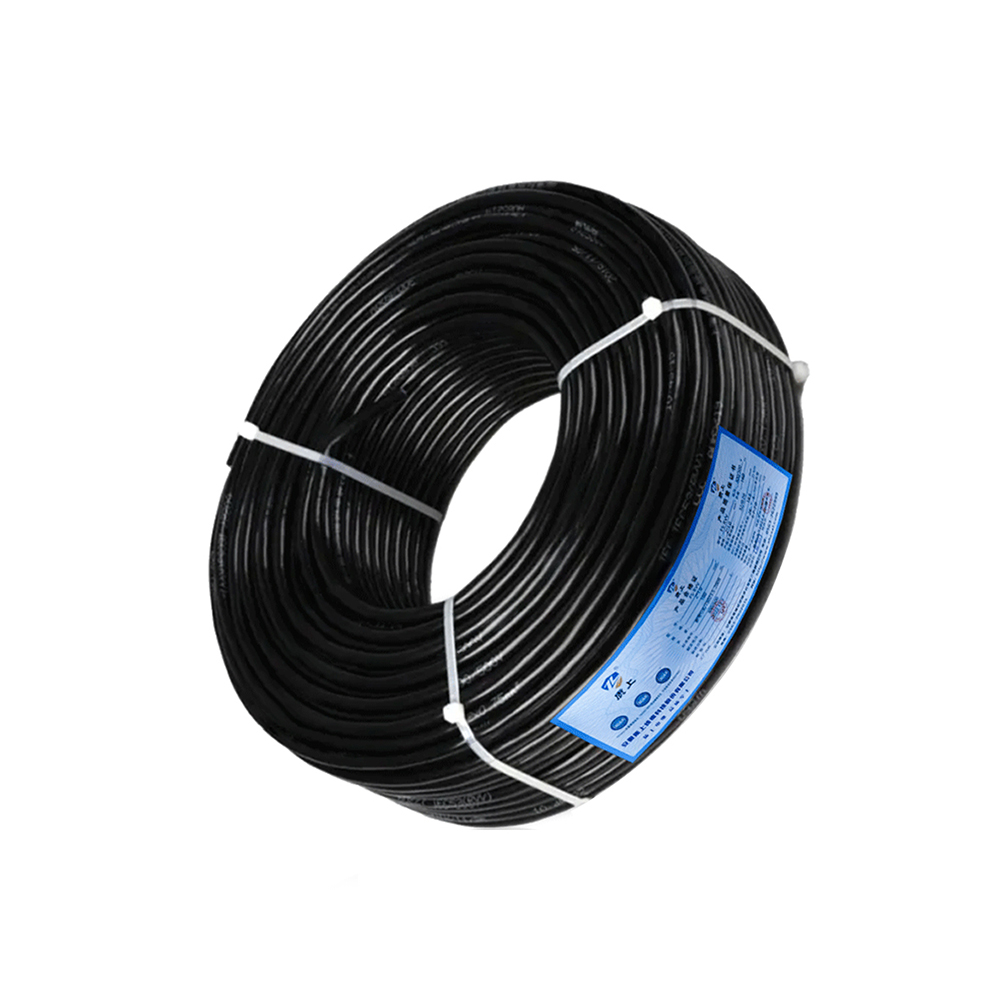
BTWGT 300/500V Flexible Mineral-Insulated Fire-Resistant Cable
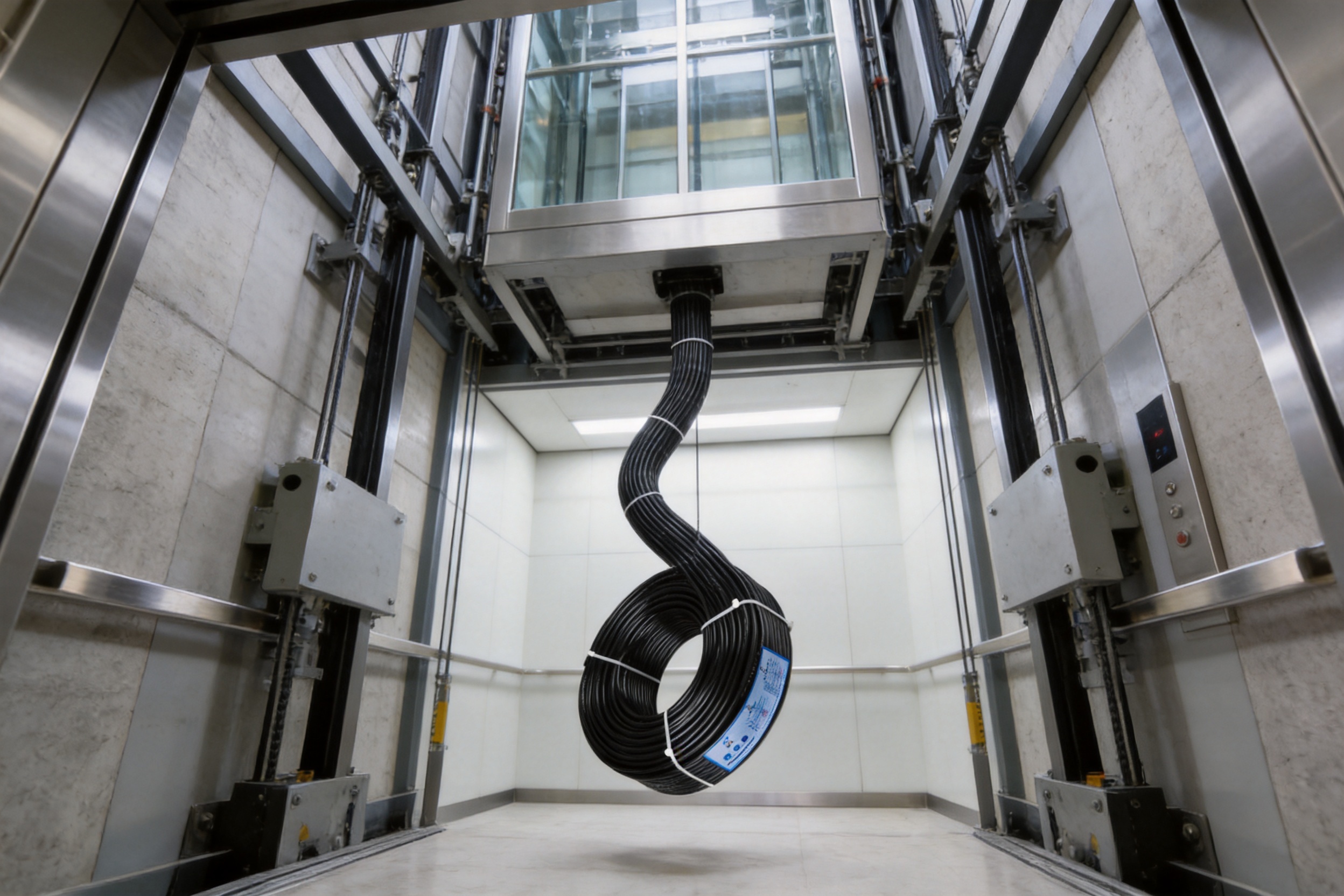
An elevator travel cable forms a moving electrical connection between the elevator car and the fixed control system. It commonly hangs beneath or alongside the car and moves whenever the car travels between floors. During this motion, the cable may experience repeated flexing, torsion, tension, compression, vibration, and contact with nearby structural components.
The cable must maintain electrical continuity despite thousands or millions of movement cycles. It must also preserve insulation resistance, prevent short circuits between cores, and protect communication circuits from excessive electromagnetic interference. In passenger elevators, the cable may support car lighting, door controls, emergency systems, intercom equipment, video monitoring, sensors, and control signals at the same time.
Traditional installations may require several separate cables. This can create a crowded shaft, increase installation labor, complicate maintenance, and make fault identification more difficult. A flat multi-core travel cable addresses these issues by grouping the necessary functions into a single organized cable structure.
Flat cable geometry is particularly useful in an elevator shaft because it distributes cores across a controlled width rather than concentrating them into a larger circular diameter. This can reduce the occupied depth of the installation and make routing easier where clearance is limited. The shape also supports the cable’s intended bending direction and helps installers maintain a predictable cable path.
However, not every flat cable is suitable for dynamic elevator service. A cable intended for fixed wiring may have conductors, insulation, fillers, and sheath materials that are not designed for repeated movement. A travel cable must be engineered as a system. Conductor flexibility, insulation adhesion, core arrangement, sheath elasticity, bending radius, tensile behavior, and manufacturing consistency all influence service life.
The product designation BTWGT is used for a flat flexible cable intended for elevator travel and similar dynamic equipment. The supplied product information identifies the rated voltage as 300/500V, with a multi-strand fine-stranded soft copper conductor, PVC insulation, and reinforced PVC outer sheathing.
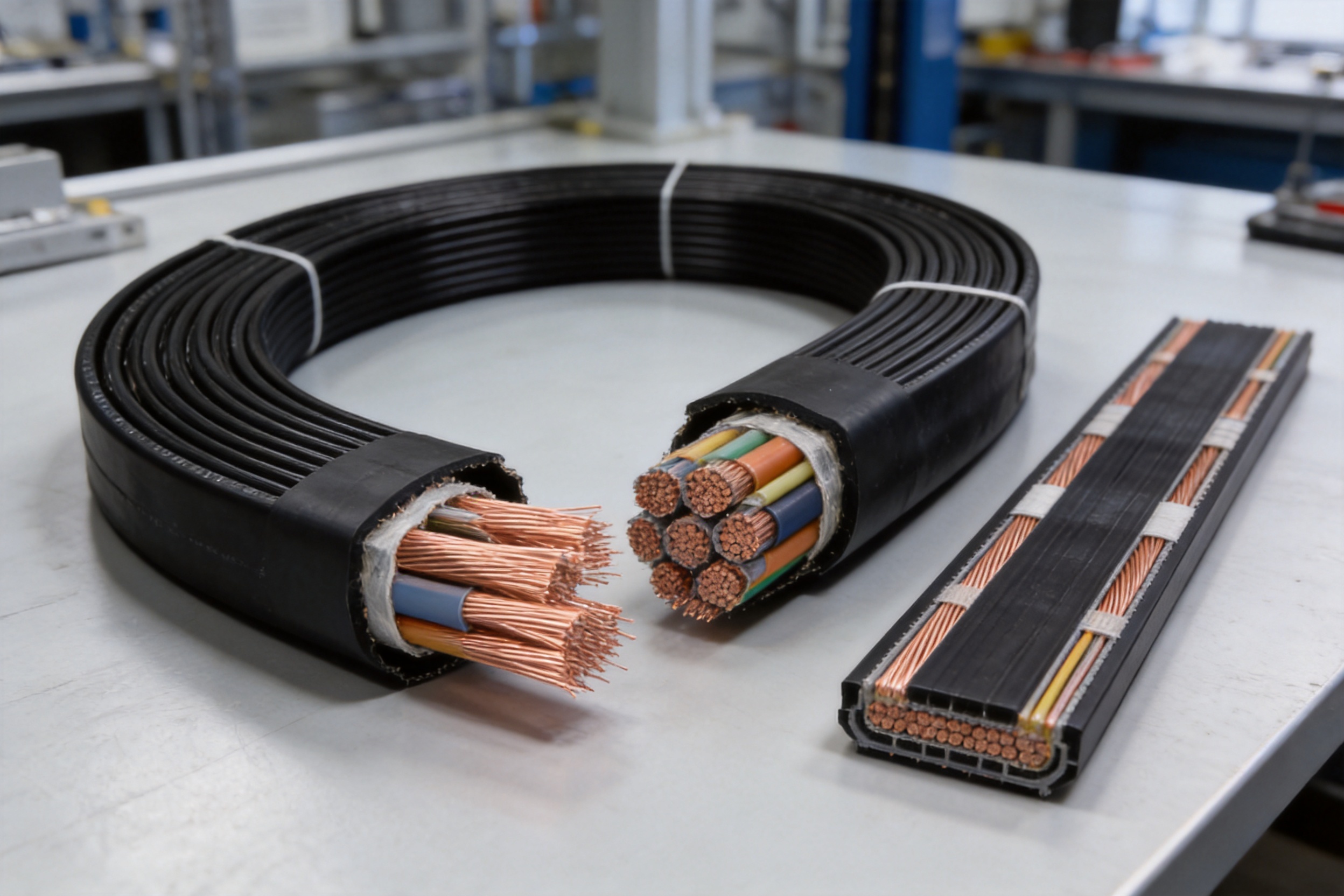
The cable can contain a combination of power cores, control cores, communication cores, and video-related cores. The number, cross-sectional area, arrangement, color identification, shielding structure, and overall dimensions can be adapted according to the equipment design and customer requirements.
| Item | Typical or Specified Product Information | Engineering Significance |
|---|---|---|
| Product type | Flexible flat travel cable | Suitable for repeated movement in elevators and related lifting equipment |
| Model | BTWGT | Identifies the specified flat travel cable family |
| Rated voltage | 300/500V in the stated configuration | Defines the intended electrical application range for the relevant model |
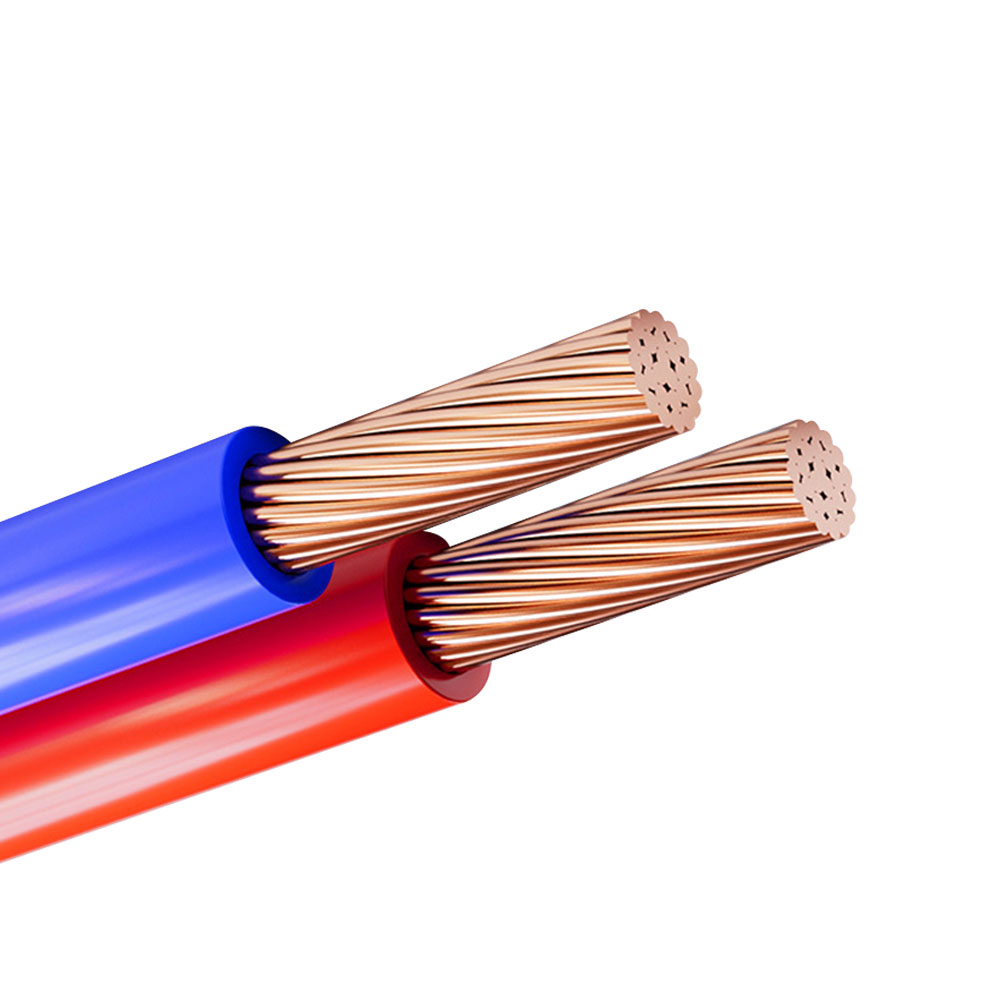
| Conductor | Fine-stranded annealed soft copper | Improves flexibility and supports repeated bending |
| Insulation | PVC in the stated product description | Provides electrical separation and mechanical protection around each core |
| Outer sheath | Reinforced PVC in the stated product description | Protects the cable assembly against abrasion, movement, and environmental exposure |
| Structure | Flat multi-core construction | Helps reduce shaft space and supports organized integration of different functions |
| Core functions | Power, control, communication, and video-related cores | Allows one cable to support several equipment systems |
| Long-term operating temperature | Approximately 70°C for the stated PVC-oriented configuration | Provides a reference for thermal application and installation design |
| Standards | GB/T 5023, EN 50214, and applicable project requirements | Supports evaluation against recognized cable and elevator cable standards |
Some technical information supplied for the broader fire-resistant cable category refers to alternative constructions involving XLPE insulation, mineral composite tape, oxygen-barrier layers, ceramicized silicone rubber, halogen-free low-smoke polyolefin sheaths, 0.6/1kV ratings, 90°C operating temperatures, and fire classifications based on IEC, GB/T, or BS standards. These features should not automatically be assumed to apply to every 300/500V BTWGT model. Customers requiring a special fire-resistant or low-smoke configuration should request confirmation of the exact material system, voltage rating, temperature class, test standard, and certificate for the selected model.
The most visible structural advantage of BTWGT cable is its flat profile. Elevator shafts often contain guide rails, counterweight systems, brackets, inspection equipment, door wiring, and other components. Available clearance can be limited, especially in modernization projects where the existing shaft cannot be substantially modified.
A flat cable can be positioned in a controlled orientation and secured using suitable clamps or suspension arrangements. Compared with multiple independent round cables, a single flat assembly may occupy less usable space and create a cleaner installation. This can help equipment designers optimize the relationship between the car, shaft wall, guide components, and traveling cable path.
The flat design also supports easier visual inspection. Installers and maintenance teams can identify the cable route, check external damage, and confirm the condition of the outer sheath without sorting through several separate cable bundles. If the cable includes clearly identified core groups, troubleshooting can become more efficient.
Space saving is not simply a matter of reducing cable volume. A compact cable arrangement can reduce the possibility of interference with moving mechanical components. In an elevator system, preventing contact with brackets, counterweights, guide rails, and other moving parts is essential. A correctly selected flat travel cable helps create a more predictable installation envelope.
For modernization projects, this advantage can be especially important. Existing elevators may have restricted shaft dimensions, legacy conduits, or limited attachment points. A custom flat cable can be designed around the available space, core requirements, travel height, car speed, and installation method.
Dynamic cable performance begins with the conductor. BTWGT cable uses multi-strand fine-stranded soft copper conductors in the described configuration. Fine stranding increases flexibility by allowing the individual copper strands to move slightly relative to one another as the cable bends.
A solid conductor or coarse-stranded conductor may be suitable for fixed wiring, but it is generally less appropriate for repeated elevator travel. Recurrent bending creates mechanical stress at the same general areas of the cable. If the conductor is too rigid, the stress can concentrate in individual strands or at the transition points between the moving and fixed sections.
Annealed copper provides a useful combination of conductivity and flexibility. It supports efficient power transmission while allowing the cable to follow the movement of the elevator car. The conductor cross-sectional area must still be selected according to current, voltage drop, ambient temperature, grouping, installation length, and applicable electrical codes.
Conductor flexibility alone does not guarantee a long service life. The conductor must be compatible with the insulation, filler, separator, and sheath system. The core arrangement must prevent excessive displacement during movement. The cable’s final dimensions must allow it to bend without placing undue pressure on individual cores.
Manufacturing consistency is also important. Variations in strand diameter, conductor resistance, insulation thickness, or core positioning can affect the cable’s dynamic behavior. A reliable manufacturer therefore controls raw materials, extrusion conditions, dimensional tolerances, conductor resistance, and finished cable testing throughout production.
Elevator systems are no longer limited to simple motor power and push-button control. A contemporary elevator may include door operators, emergency telephones, cameras, audio systems, displays, sensors, intercoms, lighting, fans, alarm circuits, load measurement, and intelligent control interfaces.
The BTWGT design can integrate different core groups in one flat cable. Power cores may supply lighting or auxiliary equipment. Control cores can connect sensors, switches, door systems, and safety-related devices. Communication and video cores can support intercom, monitoring, data transmission, or other low-voltage functions, subject to the selected design.
Integration reduces the number of independent cables that must be ordered, routed, supported, and maintained. It can also simplify project documentation. Instead of developing a separate route and installation plan for every function, the engineering team can work from one coordinated cable assembly with defined core identification.
Nevertheless, multi-function integration requires careful electrical design. Power and signal circuits may produce electromagnetic fields that can affect sensitive communication circuits if the internal arrangement is not properly planned. Separation, twisting, shielding, grounding, insulation selection, and core positioning may be used where necessary. The appropriate method depends on signal type, transmission frequency, cable length, equipment sensitivity, and system grounding.
A customized BTWGT cable can therefore be specified with different combinations of cores. The customer may define the quantity and cross-sectional area of power and control cores, the requirements of communication circuits, the need for coaxial or data-related elements, and any shielding or drain-wire arrangement. The final design should be reviewed by the cable manufacturer and the elevator system engineer before production.
Fire performance is an important subject in vertical transportation equipment because elevator cables may pass through building shafts and connect systems that support emergency communication, monitoring, lighting, or control. The terms flame retardant, fire resistant, low smoke, halogen free, and mineral insulated describe different performance characteristics and should not be treated as interchangeable.
Flame retardance generally refers to a cable’s ability to resist ignition or limit flame spread under a defined test method. Fire resistance generally refers to the ability to maintain circuit integrity for a specified period while exposed to fire conditions. Low-smoke performance concerns the amount of smoke generated during combustion. Halogen-free construction concerns the absence or controlled limitation of halogen-containing materials and the corrosive gases that may be produced during burning.
The stated BTWGT 300/500V configuration uses PVC insulation and reinforced PVC sheathing. PVC cables can be designed with flame-retardant properties, but the actual performance depends on the compound formulation, construction, cable size, grouping, and test method. If a project requires a specific fire-resistance classification, the buyer should verify that the selected model has been tested to the requested standard.
Related fire-resistant cable designs may use mica tape, mineral composite layers, ceramicized compounds, oxygen-barrier materials, intumescent layers, or halogen-free low-smoke polyolefin. During a severe fire, some of these materials can form a protective insulating or ceramicized layer around the conductors. Such constructions may be suitable for emergency power, fire alarm, smoke control, evacuation systems, or other applications requiring circuit integrity.
However, a special fire-resistant construction may change the cable’s flexibility, outer dimensions, minimum bending radius, temperature rating, voltage rating, and installation method. This is why the exact cable specification must be matched to the elevator application rather than selected only by a general product name.
For projects requiring fire testing, typical standards may include relevant parts of GB/T 19216, IEC 60332, IEC 60754, IEC 61034, BS 6387, or other national and international requirements. The applicable standard depends on the building code, project location, equipment specification, and authority having jurisdiction. Documentation should identify the tested cable model and construction rather than relying on a general statement about a product family.
The BTWGT cable offers several practical advantages over an installation based on separate conventional round cables. The first is reduced wiring complexity. One planned cable assembly can provide several functions, avoiding the need to route independent power, control, communication, and video cables through the shaft.
The second advantage is more efficient use of space. A flat profile can fit into locations where several round cables would create excessive depth or require additional supports. This is useful in compact elevator shafts, modernization projects, and equipment layouts with limited clearance.
The third advantage is installation consistency. A factory-produced multi-core assembly provides known core identification, dimensions, and grouping. By contrast, multiple cables may be purchased from different suppliers with different outer diameters, bending behaviors, and delivery schedules.
The fourth advantage concerns maintenance. When the cable functions are organized into one assembly, technicians can inspect one main travel cable and use an agreed core schedule. This can reduce the time required to trace circuits and may help maintenance teams restore service more quickly.
The fifth advantage is mechanical suitability. The product is designed for repeated elevator travel rather than only fixed installation. Fine-stranded copper conductors, flexible insulation, reinforced sheathing, and a flat arrangement work together to support dynamic service.
The product can also provide a more orderly appearance. A controlled flat cable route is easier to secure and document than a group of loosely arranged cables. Better cable management can reduce accidental abrasion, uncontrolled twisting, and contact with nearby mechanical parts.
Passenger elevators require reliable transmission between the car and the control cabinet. The travel cable may carry car lighting, door control, alarm circuits, intercom signals, display connections, fan power, sensor inputs, and other auxiliary functions. The correct core arrangement depends on the elevator manufacturer’s system architecture.
Freight elevators often operate under heavier loading conditions and may experience frequent starts, stops, vibration, and demanding operating schedules. A flexible travel cable with a reinforced outer sheath can support reliable connection between the moving car and stationary control equipment when correctly installed and maintained.
Medical elevators may require stable communication, emergency signaling, monitoring, and smooth operation. The cable may be customized to include dedicated control, communication, and video-related circuits. Signal integrity and dependable mechanical performance are particularly important where elevator availability supports hospital logistics.
Escalator systems include moving mechanical sections, drive equipment, control units, sensors, emergency switches, and monitoring components. Depending on the installation geometry, flexible flat cable designs may be used for connections between moving or vibrating equipment and fixed control systems.
Shuttle-type automated parking garages and lifting platforms require power and control connections that move with the equipment. A customized flat cable can combine motor-related auxiliary power, sensors, control signals, and communication circuits while helping maintain an organized cable route.
Construction hoists, stage lifts, and special lifting equipment may require cables that tolerate repeated travel and changing mechanical positions. The final product should be selected according to speed, travel distance, load, environmental conditions, bending arrangement, and required safety standards.
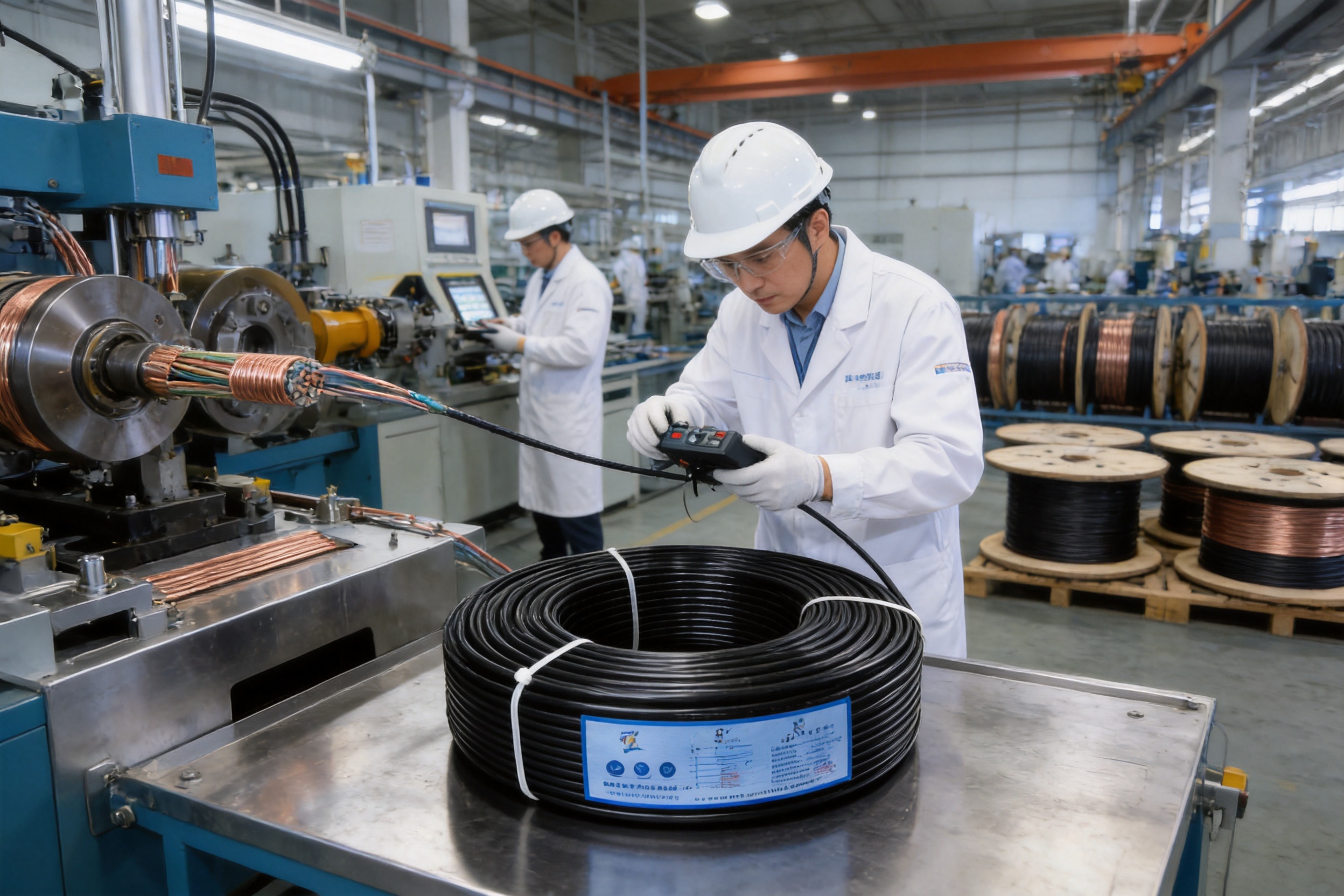
The performance of a dynamic cable depends heavily on manufacturing discipline. Anhui Zhishang Cable Technology Co., Ltd. integrates research and development, production, and sales. Its production base covers approximately 5,000 square meters and includes more than 10 automated production lines.
The company reports a monthly production capacity of up to 10 million meters across its cable product range. This capacity supports both standard products and customized orders, subject to product structure, quantity, production scheduling, and material availability. Standard cable models may be stocked for faster shipment, while customized products typically require a lead time of approximately 7 to 20 days.
Automated production lines can improve repeatability in conductor processing, insulation extrusion, core assembly, cabling, sheathing, printing, and finished-product handling. Automation does not replace engineering judgment, but it can reduce variation when supported by suitable process controls and inspection procedures.
The company’s technical and quality teams include engineers and research personnel with more than 10 years of industry experience. This experience can be valuable when customers need assistance selecting conductor sizes, core combinations, sheath materials, voltage ratings, bending requirements, or testing arrangements.
Full-core and full-length production options are emphasized as part of the company’s quality approach. Pure copper specifications are available for relevant products, supporting predictable conductivity and resistance values. Product test reports and warranty support are available for standard cable models according to the applicable product and commercial terms.
For customized cable, the production process can begin with customer drawings, samples, wiring schedules, equipment specifications, or application descriptions. Engineers can review the required cable length, core count, voltage, current, travel distance, operating speed, installation temperature, bending direction, and environmental exposure before preparing a suitable design.
Production begins with the selection and preparation of annealed copper conductors. Copper rod is drawn to the required dimensions, and individual wires are stranded to create the specified conductor cross-sectional area and flexibility. Conductor resistance, surface condition, strand arrangement, and dimensional consistency must be controlled.
The prepared conductor passes through an extrusion line where insulating material is applied. For the described BTWGT configuration, PVC insulation is used around individual cores. Extrusion temperature, line speed, concentricity, wall thickness, and surface finish are controlled to ensure reliable electrical separation.
The insulation must adhere consistently to the conductor without voids, excessive thin areas, or mechanical defects. After extrusion, cores may be cooled, identified by color or marking, and tested for dimensions and insulation performance.
Power, control, communication, and video-related cores are arranged according to the approved cable design. The sequence and spacing of cores influence overall thickness, width, flexibility, electrical interference, and bending performance.
Where necessary, fillers, separators, shielding components, or reinforcing elements can be incorporated. The aim is to maintain the planned geometry while allowing the core group to move flexibly during elevator travel.
The assembled core group is covered by reinforced PVC sheathing in the stated configuration. The sheath protects the internal cores from abrasion, moisture, dust, handling damage, and contact with installation hardware. It also provides the final flat profile and contributes to the cable’s bending behavior.
Sheath thickness, width, surface quality, color, marking, and dimensional tolerance are checked during production. The sheath must be flexible enough for repeated travel while remaining strong enough to resist normal installation and service conditions.
Finished cable inspection may include conductor resistance, insulation resistance, withstand voltage, dimensional measurement, visual examination, marking verification, and continuity testing. Dynamic or bending tests may be applied according to the product specification and customer requirements.
Where fire performance or special environmental properties are required, the relevant tests and reports should be identified before production. This ensures that the delivered cable is evaluated against the same technical basis used for project approval.
Quality control should begin before raw materials enter the production line. Copper, insulation compounds, sheath compounds, shielding materials, fillers, and packaging materials should be checked against purchasing specifications. Consistent materials are essential for stable extrusion and predictable finished-cable performance.
During production, process parameters such as extrusion temperature, line speed, conductor tension, cooling conditions, and cable dimensions should be monitored. Operators and quality personnel can use sampling inspections or continuous monitoring to identify deviations before a full production batch is completed.
Finished-cable testing verifies that the product meets the approved design. Electrical tests help confirm continuity and insulation performance. Dimensional tests confirm that the flat cable can fit the intended installation space. Mechanical and bending tests provide information about suitability for dynamic service.
Technical support is particularly important for elevator cable selection. Customers should provide as much information as possible, including elevator type, travel height, car speed, cable suspension method, number of cores, current requirements, control voltage, communication protocol, video requirements, installation temperature, expected movement cycles, and applicable standards.
Based on this information, the manufacturer can recommend a suitable cable structure. The engineering review may identify the need for additional control cores, dedicated communication elements, shielding, a different sheath compound, increased mechanical reinforcement, a different voltage rating, or a special fire-performance construction.
Customization is one of the most important advantages of working directly with a cable manufacturer. BTWGT cable can be evaluated for different core counts and cable lengths according to elevator load capacity, speed, floor height, control architecture, and installation requirements.
Customers may specify the number and size of power cores, control cores, communication cores, and video-related cores. Core colors, numbering, printing, conductor cross-sectional area, shielding, drainage wires, separators, and overall cable dimensions can also be discussed.
The rated voltage must be selected according to the equipment design. Although the stated BTWGT configuration is 300/500V, a project may require another voltage level or a different cable family. Similarly, the operating temperature must be matched to the selected insulation and sheath materials rather than assumed from a general product category.
For fire-sensitive applications, customers can request an evaluation of flame-retardant, fire-resistant, low-smoke, halogen-free, or mineral-enhanced structures. The manufacturer should then provide the applicable technical data and test documentation for the proposed construction.
Length customization can reduce field splicing and unnecessary cable waste. The required length should include the actual travel path, suspension arrangement, termination allowance, routing at both ends, and a suitable installation margin. Cutting the cable too short can create tension, while excessive unused length may interfere with moving equipment.
Before installation, inspect the cable for damage, deformation, moisture penetration, or crushed sections. Confirm that the cable model, length, core configuration, and markings correspond to the project documentation.
The cable should be installed using supports and clamps suitable for its flat profile. Clamping force should be sufficient to control the cable without crushing the sheath. Sharp edges, uncontrolled twisting, and excessive lateral movement should be avoided.
The recommended minimum bending radius must be confirmed from the product technical data. Dynamic bending requirements are different from static bending requirements, and the cable should not be folded more sharply than permitted. The natural bending direction of the flat cable should be respected throughout the travel path.
Installation should prevent contact with guide rails, counterweights, brackets, sharp structural edges, and other moving components. The cable should have adequate clearance over the complete elevator travel range, including service and inspection positions.
Terminations should be made without damaging the conductor strands or compressing the cable unnecessarily. Core identification should be checked against the wiring diagram. Power and signal circuits should be connected according to the equipment manufacturer’s instructions, with shielding and grounding handled consistently.
After installation, operate the elevator through its full travel range under controlled conditions. Observe the cable for twisting, rubbing, abnormal tension, excessive lateral movement, or contact with mechanical parts. Periodic inspection should be included in the maintenance program.
Compared with ordinary fixed-installation PVC cable, BTWGT travel cable is better aligned with repeated bending and movement. Fixed cables may have adequate electrical performance but insufficient flexibility or mechanical durability for elevator travel.
Compared with several separate round cables, the flat multi-core design can reduce installation complexity, occupied space, and the number of cable routes. It can also provide a more coordinated relationship between power and signal circuits.
Compared with some highly rigid mineral-insulated cables, a flexible travel-oriented construction is generally easier to handle and install in applications requiring continuous movement. Traditional mineral-insulated cables may provide excellent fire performance in suitable fixed applications, but their bending behavior and installation requirements must be evaluated carefully for dynamic elevator use.
Compared with low-cost, non-specialized flexible cable, an application-specific travel cable offers a more suitable combination of core arrangement, bending design, sheath reinforcement, and technical documentation. The initial purchase price should therefore be evaluated together with installation labor, maintenance access, replacement frequency, and downtime risk.
Compared with importing a standard cable that cannot be modified, a manufacturer offering OEM and ODM support can adapt the design to the equipment. This may prevent unused cores, reduce cable size, or add circuits needed for a particular elevator control system.
The first selection factor is electrical loading. Determine the current carried by each power circuit, expected voltage drop, conductor cross-sectional area, duty cycle, and ambient temperature. Control and communication circuits should be reviewed separately because they may have different voltage and signal requirements.
The second factor is mechanical movement. Confirm the elevator travel height, car speed, acceleration, movement frequency, suspension method, bending radius, and expected operating cycles. A cable designed for a short, slow travel path may not be appropriate for high-speed or high-cycle equipment.
The third factor is environmental exposure. Consider temperature, humidity, dust, oil, cleaning chemicals, ultraviolet exposure, vibration, and possible abrasion. The sheath and insulation materials should be chosen for the actual environment.
The fourth factor is electromagnetic compatibility. If the cable carries sensitive communication or video signals alongside power and control circuits, review the need for separation, shielding, twisting, grounding, or dedicated communication elements.
The fifth factor is fire and regulatory performance. Identify the exact standard required by the building project, local regulations, elevator manufacturer, consultant, or end user. Request test reports that correspond to the proposed cable construction and model.
The sixth factor is delivery. Standard products may be available from stock, while customized products generally require production scheduling. A clear technical drawing and complete core schedule can reduce approval time and help achieve the expected delivery period.
Cable manufacturing uses copper, polymers, packaging materials, electricity, and production resources. Responsible production therefore includes material efficiency, process stability, reduced scrap, appropriate packaging, and careful control of rejected products.
Automated production lines can help reduce dimensional variation and unnecessary material waste. Accurate conductor sizing, controlled extrusion, and consistent cable lengths may improve material utilization. Quality control also prevents resources from being spent on large quantities of cable that fail to meet the approved specification.
Environmental performance should be evaluated according to the actual cable construction. PVC products and halogen-free low-smoke products have different material systems and combustion characteristics. Customers should select the construction required by the application rather than relying on generalized environmental claims.
The company reports an emphasis on green manufacturing and responsible production practices. For international projects, customers may request documentation related to restricted substances, material declarations, RoHS-related requirements, packaging, and product compliance according to the destination market.
Anhui Zhishang Cable Technology Co., Ltd. serves domestic and international customers and reports product sales in markets including the United States, Canada, Australia, Japan, and parts of Eurasia. International supply requires attention to standards, labeling, packaging, documentation, communication, and delivery coordination.
For overseas projects, the buyer should provide the destination country, required standards, import documentation needs, preferred packaging, cable drum or coil requirements, marking language, and inspection expectations. The manufacturer can then evaluate whether the standard product is suitable or whether a market-specific design is necessary.
OEM and ODM support allows the cable to be developed from customer drawings or samples. This is useful for elevator manufacturers, control-system integrators, distributors, engineering contractors, and maintenance companies that need a cable matching an existing wiring schedule.
Technical communication is most effective when the customer provides a complete specification. A simple product name may not define the required fire performance, shielding, voltage, temperature, bending life, or core arrangement. Detailed information helps the manufacturer prepare an accurate quotation and reduces the possibility of later changes.
Its primary application is elevator travel wiring. It can also be considered for escalators, automated parking lifting systems, construction hoists, stage lifts, and other equipment requiring flexible multi-core connections between moving and fixed components.
It is a flat cable. The flat structure is intended to reduce shaft space, support organized core integration, and provide a controlled installation profile for repeated elevator travel.
The stated BTWGT configuration is rated at 300/500V. If a project requires 0.6/1kV or another rating, the customer should request a separate technical confirmation because voltage rating is linked to insulation design, dimensions, testing, and application requirements.
The product description specifies multi-strand fine-stranded soft copper conductors. Annealed copper provides good conductivity and flexibility for dynamic service.
Yes. The structure can integrate power cores, control cores, communication cores, and video-related cores. The exact arrangement should be designed to suit the electrical load, signal type, electromagnetic compatibility requirements, and elevator control system.
The stated 300/500V configuration uses PVC insulation and reinforced PVC sheathing. Alternative fire-resistant, low-smoke, halogen-free, XLPE, mineral-enhanced, or ceramicized constructions may be available for special requirements, but they must be confirmed for the exact model.
Fire performance depends on the exact material system and tested construction. The product category and supplied technical information refer to fire-resistant applications, but customers should request the applicable test report and confirm whether the required classification concerns flame retardance, fire resistance, low smoke, halogen-free performance, or circuit integrity.
The stated PVC-oriented configuration identifies a long-term operating temperature of approximately 70°C. Some alternative constructions may be rated at 90°C or another temperature. The final value must be confirmed from the technical data sheet for the selected model.
Yes. Core count, core size, cable length, functional grouping, marking, shielding, and other construction details can be discussed according to the elevator design and project requirements. Customization may also cover different sheath materials or fire-performance requirements.
Provide the elevator or equipment type, travel height, speed, movement frequency, number of cores, conductor sizes, voltage, current, communication requirements, video requirements, environmental conditions, desired length, fire standard, delivery location, and any drawing or sample available.
The supplied information identifies GB/T 5023 and EN 50214, with some models potentially available with CE certification. The relevant standard depends on the exact product configuration and destination market. Certification should be verified for the model being purchased.
Yes. The company supports development based on customer drawings or samples. Its engineering team can assist with product selection and tailor-made cable design solutions.
Customized products typically require approximately 7 to 20 days of lead time, subject to design confirmation, quantity, material availability, production scheduling, and testing requirements. Standard products may be available for faster shipment.
Its fine-stranded copper conductors, flexible core construction, flat geometry, reinforced sheath, and design for repeated bending and twisting make it suitable for dynamic elevator environments when the cable is correctly specified and installed.
Not automatically. The cable can integrate many functions, but the final design must consider current capacity, communication performance, shielding, safety circuits, fire requirements, and the elevator manufacturer’s wiring architecture. An engineering review is recommended before replacement.
Before placing an order, confirm the exact model designation, rated voltage, conductor material, conductor cross-sectional area, number of cores, insulation material, sheath material, overall dimensions, operating temperature, minimum bending radius, and required cable length.
Confirm whether the cable is intended for power only or for combined power, control, communication, and video functions. If signal circuits are included, define the signal type and any shielding or separation requirements.
Confirm the required fire-performance standard. Do not use a general “fire-resistant” description as a substitute for a test classification. Request model-specific documents where the project requires flame spread, circuit integrity, smoke emission, halogen-free, or corrosive gas performance.
Confirm inspection and documentation requirements, including test reports, certificates, packing lists, cable markings, drum labels, certificate of conformity, warranty terms, and any third-party inspection.
Finally, confirm the installation conditions with the elevator manufacturer or system integrator. A cable may meet its electrical specification and still be unsuitable if it is routed with excessive bending, poor support, inadequate clearance, or incompatible clamps.
BTWGT 300/500V flexible flat cable is designed to address the combined electrical and mechanical requirements of elevator travel systems. Its fine-stranded copper conductors support flexibility, while the flat multi-core structure helps save shaft space and integrate power, control, communication, and video-related functions.
Compared with ordinary fixed cable or multiple separate round cables, the product can simplify routing, reduce installation complexity, improve functional organization, and support more efficient maintenance. Its value is especially clear in compact shafts, elevator modernization projects, and dynamic lifting equipment where repeated movement is unavoidable.
The product should nevertheless be selected according to a confirmed technical specification. The supplied information includes a PVC-based 300/500V configuration as well as references to alternative fire-resistant constructions. These alternatives may differ in insulation, sheath, voltage rating, temperature rating, bending behavior, and certification. Customers should therefore verify the exact model and test documentation required for their project.
Anhui Zhishang Cable Technology Co., Ltd. strengthens the product offering through integrated R&D, manufacturing, quality control, OEM/ODM support, automated production capability, and international supply experience. With a production base of approximately 5,000 square meters, more than 10 automated production lines, reported monthly output of up to 10 million meters, and technical personnel with substantial industry experience, the company can support both standard orders and customized cable development.
For elevator manufacturers, engineering contractors, distributors, equipment integrators, and maintenance organizations, the most effective approach is to provide complete application information at the quotation stage. When the cable structure is matched correctly to the equipment, installation environment, movement profile, and applicable standards, BTWGT cable can provide a dependable and space-efficient connection solution for modern dynamic systems.
GB/T 5023, Polyvinyl Chloride Insulated Cables of Rated Voltages up to and Including 450/750V.
EN 50214, Flexible Cables for Lifts and Hoists.
IEC 60332, Tests on Electric and Optical Fibre Cables Under Fire Conditions.
IEC 60754, Test on Gases Evolved During Combustion of Materials from Cables.
IEC 61034, Measurement of Smoke Density of Cables Burning Under Defined Conditions.
GB/T 19216, Test Methods for Fire Resistance of Cables and Optical Fibre Cables Under Fire Conditions.
BS 6387, Performance Requirements for Cables Required to Maintain Circuit Integrity Under Fire Conditions.
Manufacturer technical information for BTWGT flexible flat elevator travel cable, including product structure, application guidance, manufacturing capability, and customization support.

We firmly believe that good cables are not only a competition of materials, but also a reflection of craftsmanship, quality, and responsibility.

Links
Product
Send Inquiry
No. 29 Sankeshu Road, Xuanzhou District, Xuancheng City, Anhui Province, China
+86-18621104555/+86-563-2622999
 Electrical Cable Manufacturer
OEM/ODM Wire and Cable Solutions
Electrical Cable Manufacturer
OEM/ODM Wire and Cable Solutions
 English
 Español
 عربى
عربى
 русский